Card Values: Only the Last Digit Counts
Scoring is the only part that trips beginners up, and only for a few rounds.
| Card | Value |
| Ace | 1 |
| 2-9 | Face value |
| 10, J, Q, K | 0 |
If a hand goes over nine, drop the first digit. 7 + 8 = 15, so the hand is worth 5. King + 9 is 9, the best hand in the game. So unlike blackjack, you can’t bust.
Punto banco is usually dealt from six or eight decks shuffled together in a shoe, the box the dealer pulls cards from.
The Third Card
This is the rule that makes people think baccarat is complicated. You don’t actually need to know it, because the dealer or the software applies it for you. It’s still worth understanding, so you know why Banker got a card and Player didn’t.
The Player hand always follows the same rule:
- 0-5 ➡️ draws a third card
- 6-7 ➡️ stands
- 8-9 ➡️ natural, the round ends
Does the Banker Draw a Third Card?
What Banker does depends on Player’s third card. Here’s the full chart. D = Banker draws, S = Banker stands.
Find the row for the Banker’s total and the column for what the Player did.
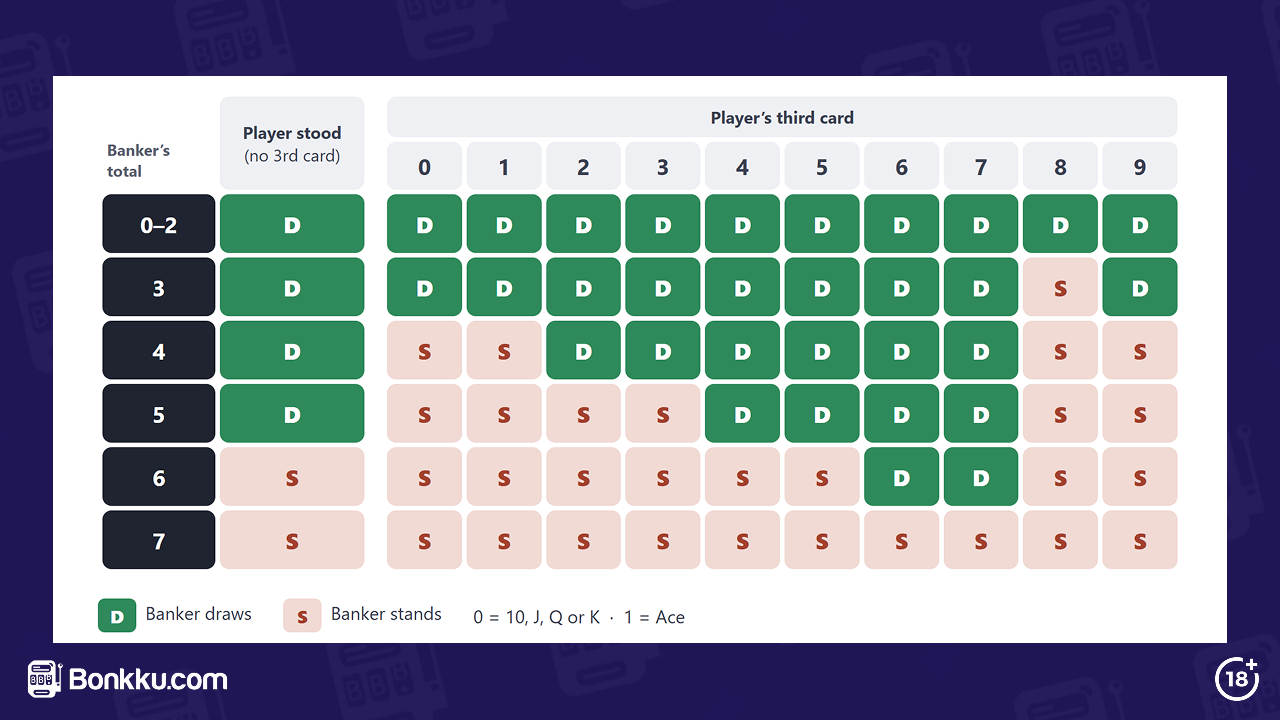
A quick way to remember it: if Player stood, Banker plays exactly like Player (draws on 0-5, stands on 6-7). If Player drew, the lower Banker’s own total, the more likely it is to draw.
Three Sample Hands

Hand 1 – A natural ends everything
Player has 4 + 5 = 9. Banker has K + 6 = 6. Player wins on the spot and nobody gets a third card.
Hand 2 – Banker stands on a low total
Player has 2 + 3 = 5, so it draws and gets an 8. That makes 13, which counts as 3. Banker has 10 + 3 = 3. The chart says Banker stands on 3 when Player’s third card is an 8. It’s 3-3, a tie.
Hand 3 – Six draws
Player has Q + 4 = 4 and draws a 7, giving 11, which counts as 1. Banker has 3 + 3 = 6. Player’s third card was a 7, so Banker draws and gets a 2. Banker wins 8-1. Banker was already winning on 6, but the chart says draw, and the dealer doesn’t take votes.
Banker, Player or Tie? Payouts and House Edge
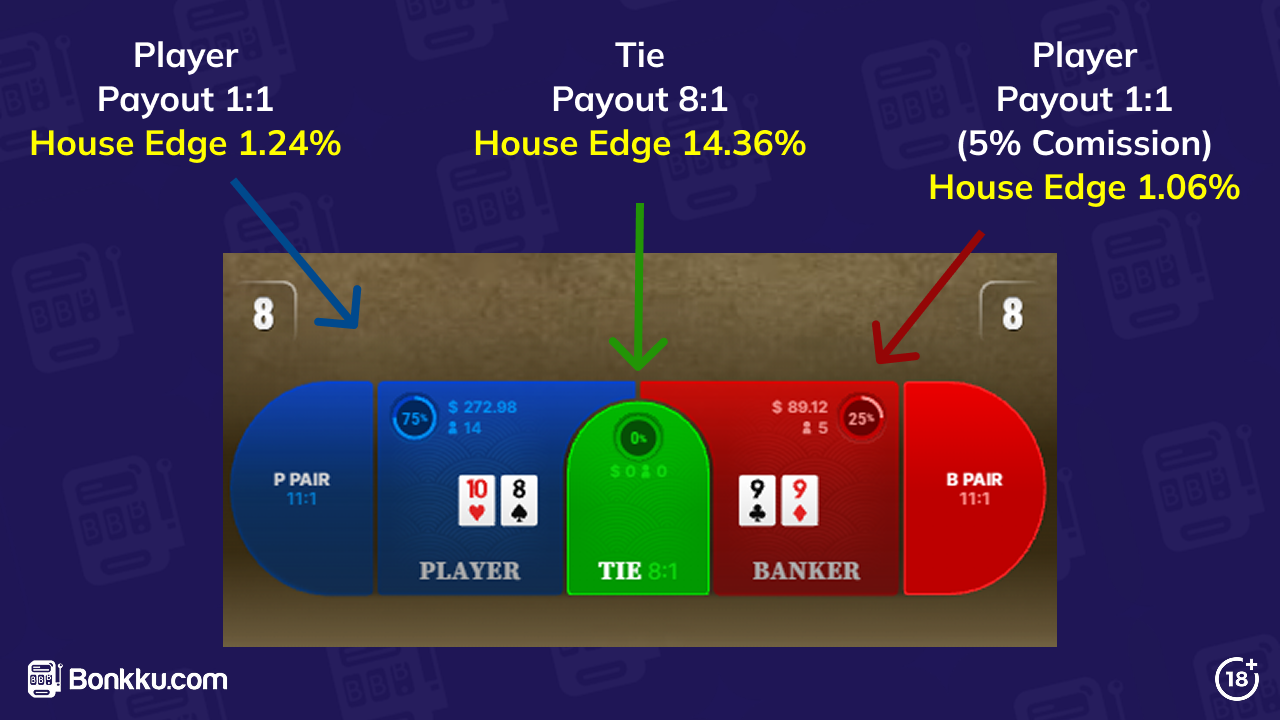
Banker wins slightly more often because it always acts after Player. That’s why a winning Banker bet usually pays 5% commission. Bet €100, win, and you collect €95 profit.
| Bet | Payout | Probability (8 decks) | House edge | RTP |
| Banker | 1:1 minus 5% commission | 45.86% | 1.06% | 98.94% |
| Player | 1:1 | 44.62% | 1.24% | 98.76% |
| Tie | 8:1 | 9.52% | 14.36% | 85.64% |
| Tie (e.g. some UK tables) | 9:1 | 9.52% | 4.84% | 95.16% |
About one round in ten ends in a tie. Leave ties out and Banker wins roughly 50.7% of the decided rounds. That’s a thin margin, but even after commission it makes Banker the best basic bet in the game.
Side Bets
Side bets are where the table tempts you with big numbers. Here are the common ones and what they cost:
- Player Pair / Banker Pair: the first two cards of the hand are a pair. Usually pays 11:1, with a house edge of about 10.4%.
- Dragon 7 (EZ Baccarat): Banker wins with a three-card 7. Pays 40:1, with a house edge of about 7.6%.
- Panda 8 (EZ Baccarat): Player wins with a three-card 8. Pays 25:1, with a house edge of over 10%.
- Dragon Bonus, Perfect Pair, Either Pair: paytables vary between game providers, so always check the exact payouts on that game’s info page.
A Short History of Baccarat
Nobody agrees on where baccarat began. The most popular story says Italian soldiers brought it to France in the late 15th century. Some historians date modern baccarat to the 19th century and trace it back to a card game called Macao. Macao spread across Europe in the late 18th century, and the King of Sardinia banned it in 1788.
The earliest French form was baccarat banque, where the banker’s seat stayed fixed. The quicker chemin de fer came along in the late 1800s. The name means “railway”, because the shoe travels from player to player like a train. It was an aristocrats’ game. Its most famous scandal, the Tranby Croft affair of 1890-91, went all the way up to the Prince of Wales.
Punto banco, the version most people play today, took shape in 1940s Havana. The casino is always the bank and players never decide whether to draw. It reached Las Vegas at the Sands in November 1959. From there it travelled to Asia, where it became by far the biggest game in the halls.
In popular culture, baccarat is James Bond’s game. In the original Casino Royale novel, Bond plays chemin de fer. The poker came with the 2006 film.
Modern Baccarat Variants
Most new versions change one thing: how a winning Banker bet gets paid. So we compared them by asking how much of a €100 Banker win you actually keep, and what the bet’s long-term house edge is.
| Version | What changes | What you keep from a €100 Banker win | Banker house edge | RTP |
| Punto banco / mini baccarat | Standard 5% commission | €95 every time | 1.06% | 98.94% |
| EZ Baccarat | No commission, but a Banker win with a three-card 7 is a push | €100, except €0 on a three-card 7 (stake returned) | 1.02% | 98.98% |
| No Commission / Super 6 | No commission, but a Banker win on 6 pays 1:2 | €100, except €50 on a 6 | 1.46% (8 decks) | 98.54% |
| Player bet (for comparison) | – | Player win pays €100 | 1.24% | 98.76% |
| Tie 8:1 (for comparison) | – | Tie win pays €800 | 14.36% | 85.64% |
Here’s the catch. Commission-free baccarat usually costs more than the version with commission. The 5% looks like a fee, but the half payout on a winning 6 takes more. Banker wins on 6 aren’t rare, and each one costs you half your win at once: €50 instead of €5. EZ Baccarat is the exception, with a house edge slightly below standard.
Online Baccarat
RNG baccarat is a digital table game run by a random number generator, and it’s the quickest way to play. There’s no dealer. The cards are often reshuffled every round (some games simulate an eight-deck shoe instead), and a hand takes a few seconds. It’s a good way to learn the rules, and many titles have free versions too. Bonkku’s demo casino page has options if you want to try before you bet.
That speed is also the risk. You can fit many times more rounds into an hour than at a live table, so even a small house edge adds up fast. Stakes often start at a few tens of cents, but the game only stays cheap if you control the pace.
Live Baccarat
Baccarat is one of the biggest categories at any live casino. In the studio, a dealer shuffles a real shoe, and cameras and card recognition systems put the cards on your screen. You’ll find more variety than any land-based casino can offer. The biggest providers are:
- Evolution
- Pragmatic Play Live
- Playtech
- Ezugi
- Winfinity
- Lucky Streak
- SA Gaming
- Iconic 21

Speed Baccarat
The cards are dealt face up with no pauses, so a round of Evolution’s Speed Baccarat lasts about 27 seconds, roughly half the usual time. The rules are the same as punto banco. It suits players who want a live table without the waiting.
Squeeze and Peek
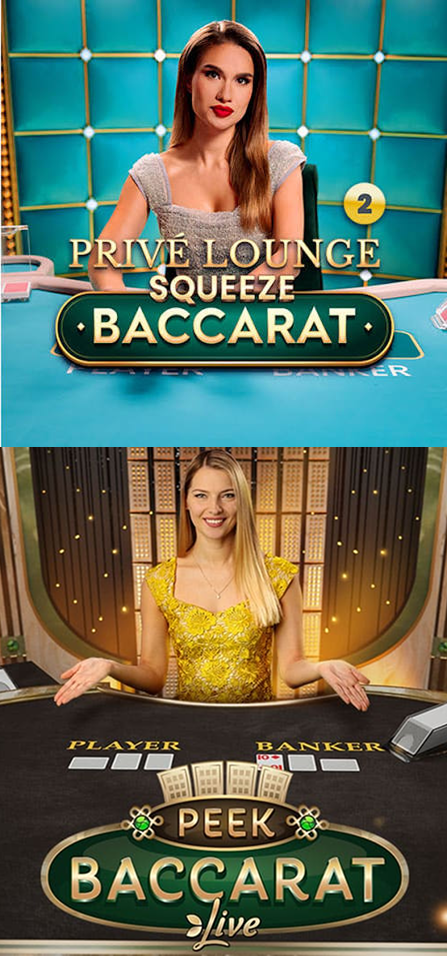
In a squeeze, the card is revealed slowly, one edge at a time. The ritual comes from Asian VIP rooms, where players bend the cards themselves. At most live tables the dealer does it while the camera zooms in, but in games like Evolution’s Baccarat Control Squeeze you peel back the corner yourself on screen, as slowly as you like.
Rounds take longer, and that’s the point. Squeeze fans play for the moment a corner lifts and the whole table goes quiet. The house edge stays the same.

Lightning Baccarat and Other Multiplier Games
In Evolution’s Lightning Baccarat, 1-5 Lightning Cards are drawn each round, carrying multipliers of 2x, 3x, 4x, 5x or 8x. If a winning hand contains more than one Lightning Card, the multipliers are multiplied together, and the top win on a Player or Banker bet is 512 times your stake. You pay for that with a 20% fee on your main bet, so a €10 bet really costs €12. RTP is 98.76% on Player, 98.59% on Banker and 94.51% on Tie, and the game uses an eight-deck shoe. Evolution’s Golden Wealth Baccarat and Pragmatic Play’s Mega Baccarat belong to the same multiplier family.
The Relatives: Dragon Tiger and Bac Bo
Dragon Tiger is baccarat cut down to the basics: each side gets one card, and the higher card wins. Bac Bo uses dice instead of cards. Neither one follows baccarat’s rules, but both sit in the same live casino lobby and attract the same players.
Live lobbies also tend to have multi-shoe tables, VIP or Salon Privé rooms with high minimum bets, and No Commission tables.
Roadmaps Explained
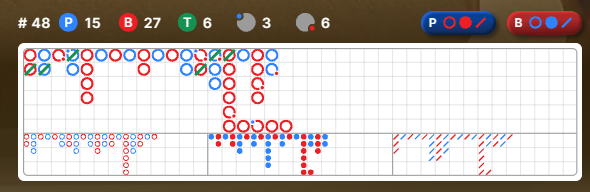
Every live baccarat table shows a grid of red and blue marks. In Asian casinos, players track them with pen and paper. Here’s what each board shows:
| Board | What it shows |
| Bead Plate | Every round in order, each as its own bead (red Banker, blue Player, green Tie) |
| Big Road | Streaks: the same winner continues down a column, a new winner starts a new column |
| Big Eye Boy | A derived board: is the Big Road repeating the pattern of the previous column? |
| Small Road | Same idea, but compares with the column two places back |
| Cockroach Pig | Same idea, but compares with the column three places back |
None of them predict anything. Each hand is effectively independent of the last one. Six Bankers in a row don’t make Player “due”, and they don’t make Banker “hot”. The boards are history plus entertainment, and they’re very good at keeping people in their seats. Enjoy watching them. Just don’t let them set your stakes.
Baccarat in a Land-Based Casino
Baccarat in a real casino comes in two very different sizes.
Big table baccarat is the traditional version. It usually has its own high-limit room behind a rope or a glass door.
- 12 to 14 seats, steep minimums and a quiet room
- Players handle the cards, and the shoe moves to whoever has the most money on the hand
- You probably won’t find a seat 13. In casinos with many Asian players, seat 4 often disappears too
Mini baccarat is what you’ll see on the main floor. Seven seats, the dealer does everything, and the minimum bet is close to blackjack.
The private VIP table
At the very top, the table is yours alone. Every deck is used for one shoe only and then thrown away.
That’s why you can fold a card in half, bend the corner until it turns white or tear it when you peek. For many high rollers the squeeze is the best part of the game.
At an ordinary big table it’s different. The cards have to last the whole night, so squeeze all you like, but don’t tear them or lift them off the table.
Where to play
Macau is the capital of baccarat, with Singapore and Las Vegas right behind. In Europe, the classic casinos of Monaco and London still deal it.
Baccarat Strategy
You make no decisions once the cards are out, so there’s no “basic strategy” like in blackjack. The only real choice is your bet:
- Bet Banker or Player. Banker is slightly cheaper, but the gap is small.
- Skip the Tie and the side bets, unless you’re knowingly paying for entertainment.
- Pick the cheapest version. Standard commission or EZ is usually better than No Commission or the multiplier games.
Progressive betting systems such as Martingale (double after a loss), Paroli (double after a win) and Fibonacci don’t change the house edge. They only change how your wins and losses are spread out. With Martingale you get lots of small wins, until one long losing streak hits the table maximum or empties your bankroll.
Conclusion
You can learn the rules in one evening: pick Banker, Player or Tie and let the rules do the rest. Banker is the best bet mathematically, with a house edge of 1.06%. Player is close behind, while the Tie and the side bets cost several times more. The version you choose matters more than most people expect. A commission-free table often costs more than a standard one, and multiplier games charge you an extra fee for the thrill.
Online you can play RNG tables and free versions. Live casinos offer speed, squeeze and Lightning tables, and a land-based casino gives you the real salon experience. The roadmaps are fun to watch, but they predict nothing.
The takeaway: bet Banker at a standard commission table and you’re paying about as little as baccarat allows. Next step: pick a site from Bonkku’s best casinos, check its licence and set your deposit limit before your first hand.


 7.8 / 10.0

 Minimum Deposit 20€
 Claim Bonus

















 Table of contents
