Complaint Routes by License
| License | Where you complain after the casino | Deadline to know | Language | Player protection |
| MGA (Malta) | ADR body named in the casino’s terms, plus an MGA complaint | Check the casino’s terms | English (or Maltese) | Strong |
| Isle of Man (GSC) | GSC complaint form | Review request within 14 days of the GSC’s decision | English only | Good |
| EMTA (Estonia) | Estonian Consumer Disputes Committee, plus a report to EMTA | – | Estonian | Good |
| Curaçao (CGA) | CGA-approved ADR body | Check the casino’s complaint policy | English | Improving |
| Kahnawake (KGC) | KGC directly, by email or form | No sooner than 7 days and no later than 6 months after the problem arose | English | Moderate |
| Tobique | Independent dispute body named by the casino. License breaches to TGC via the license seal | – | English only | Moderate |
| Anjouan | Complaint through the casino’s license seal, then an approved ADR body | 30 days for payment and account disputes, 14 days for game disputes | English only | Weak |
| No license | Bank or payment provider, public complaint sites, police if it’s a scam | Card chargeback deadlines | | Very weak |
MGA: Dispute Body First, Regulator Alongside
An MGA-licensed casino gives you the clearest route, but it works differently from what most players expect. Since 1 April 2019, the MGA’s Player Support unit no longer rules on individual disputes between a player and a casino. It still takes complaints as part of its supervision, checks whether the operator followed the law and its license, and can act against it. Whether your winnings should be paid is decided by an independent ADR (alternative dispute resolution) body, which every MGA casino must name in its terms.
- Get the casino’s final answer in writing.
- Take the case to the ADR body named in the terms. They are usually free for players.
- File a complaint with the MGA through its Lodge a Complaint form at the same time. The form asks for the reason (payments, bonuses, KYC, account closure, technical issues), the website, operator, username, game, amount in dispute and the date and time.
If the form fails, take a screenshot of the error and use the MGA’s general contact channel instead. That way you can show you tried to complain in time.
Isle of Man: A Strict but Fair Process
The Isle of Man Gambling Supervision Commission (GSC) is one of the longest-running online gambling regulators. It only looks into complaints about its own licensees, so check the register first. Players based in the UK are directed to the UK Gambling Commission instead.
The GSC won’t touch your complaint until you have gone through the casino’s own complaints process to the end. Once you have, use the GSC’s online Make a complaint form and attach all your correspondence with the casino, along with the specific terms you believe were broken. Everything must be in English, or the complaint won’t be processed. The GSC can ask the operator for its side and decides based on the evidence. If you think it got the decision wrong, you can ask for a review in writing within 14 calendar days. The review is done by an independent senior inspector, and that decision is final.
EMTA: Estonia’s Regulator Supervises, a Committee Decides
The Estonian Tax and Customs Board (EMTA) issues and supervises gambling licenses in Estonia, and many EMTA casinos serve players across the Nordics. Like the MGA, EMTA is a supervisor, not a judge. Under its license conditions, for example, winnings may only be paid to the bank account the player deposited from. But whether your specific winnings belong to you is decided by the Consumer Disputes Committee (Tarbijavaidluste komisjon), which works alongside Estonia’s Consumer Protection and Technical Regulatory Authority (TTJA) but is independent of it.
The committee’s published decisions show where it stands. In spring 2022 it ruled that a bookmaker had to pay a voided €1,100 win because it couldn’t prove the pricing error it claimed. In October 2024 a casino had to return €200 left in a closed account. In December 2023 a player’s claim was rejected: the casino hadn’t blocked the withdrawal, it was waiting for a standard ID and payment check, and the claim didn’t state a clear demand for money.
Proceedings are free, a decision usually comes within 90 days of the case being accepted, and applications go through TTJA’s e-service or by email to [email protected]. The catch for international players is language: the process runs in Estonian. If you live in another EU country, Norway or Iceland, your national European Consumer Centre can help with cross-border cases. Check with them first that the committee will take a claim from a non-resident. Alongside this, you can report license breaches to EMTA as the supervisor.
Curaçao: New Rules Since 2025
Curaçao’s licensing system was rebuilt under the new LOK law. The old sub-licenses are gone, and licenses are now issued by the Curaçao Gaming Authority (CGA). The most important change for players is the CGA’s Player Complaints Policy Guidelines (version 1.1, 18 June 2025), which Curaçao casinos had to follow from 31 July 2025. Every licensee must offer support by email or chat and a formal complaint form, and if you’re not satisfied, refer you on to an independent ADR body approved by the CGA. Complaints about responsible gambling get priority.
The system is still young, and practice is settling in. Check the CGA register that the license was issued under the LOK law and belongs to the company you actually have an account with.
Kahnawake: Straight to the Commission
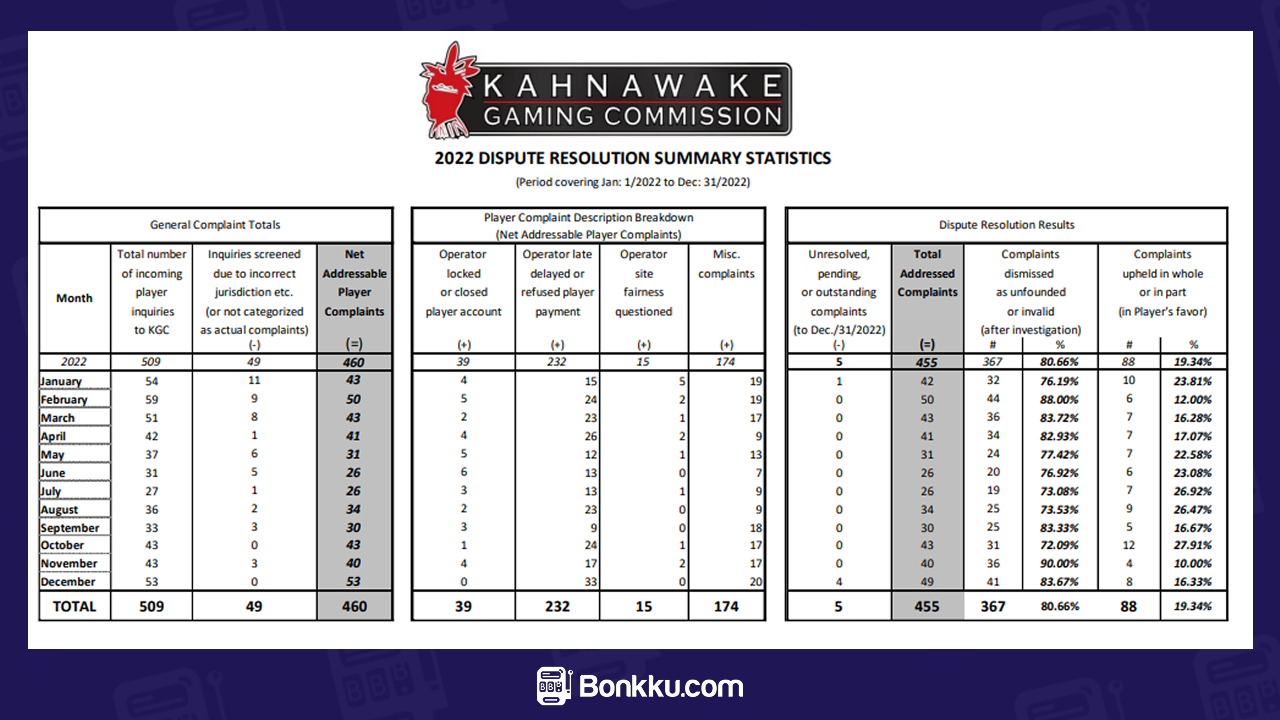
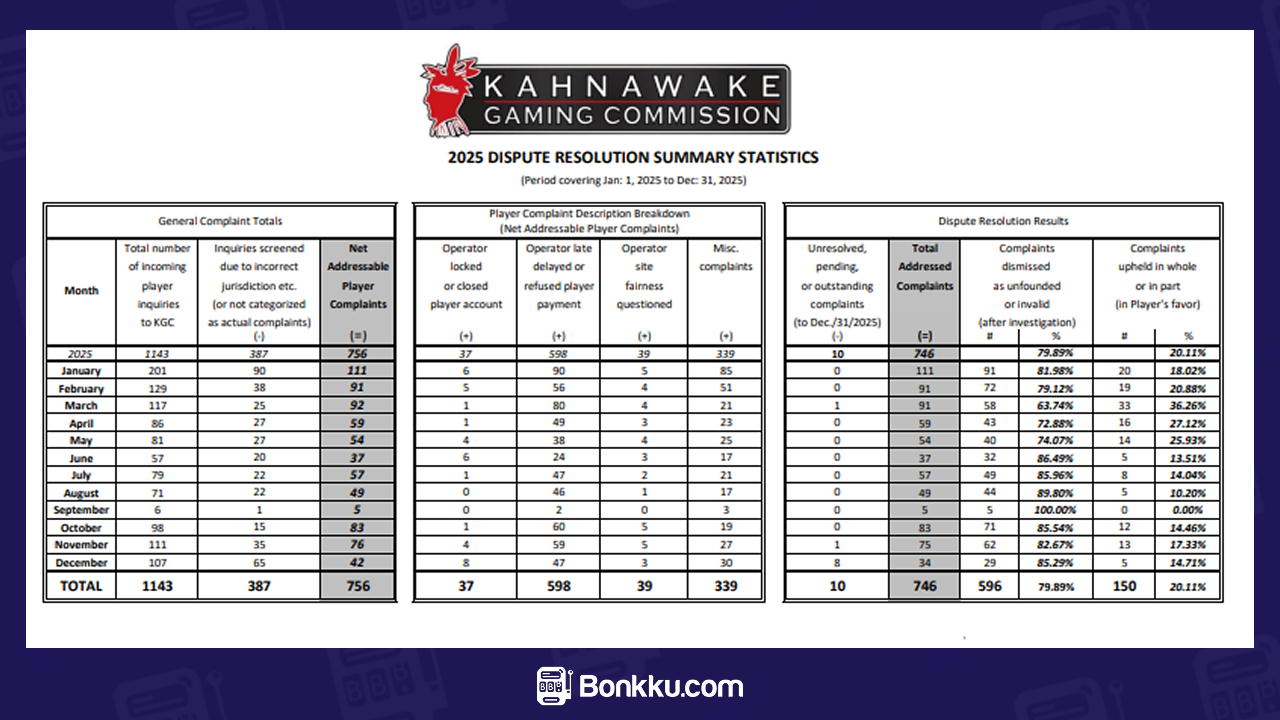
The Kahnawake Gaming Commission (KGC), based in the Mohawk Territory of Kahnawake near Montreal, handles complaints itself. Send yours to [email protected] or use the form on its website, and include your name, email, date of birth, country, the casino’s name, your username or customer number, the date of the problem and a description. Take it to the casino first. The KGC doesn’t accept complaints by phone.
The rules are in Part XXIV of the KGC’s Regulations Concerning Interactive Gaming, amended on 25 March 2026. Your complaint must clearly identify you, describe what you’ve already done with the casino, and arrive no sooner than 7 days and no later than 6 months after the problem first arose. The operator then has 7 days to give the KGC a full response. Once it has investigated, the KGC can dismiss the complaint, uphold it in whole or in part, or order the operator to take whatever steps it considers necessary.
Six months sounds like plenty, but a dispute that drags on with the casino eats it up quickly. Put the date in your calendar the day the problem starts.
Tobique: The Complaint Form Behind the Seal
The Tobique Gaming Commission (TGC) licenses operators under the Tobique Gaming Act 2023, and a growing number of Tobique casinos serve European players. Click the TGC seal in the casino’s footer and you land on validate.thetgc.ca, which shows the license holder, its address, the registered website and the license status (Operating status: VALID). The same page has a File a Complaint button.
Read the fine print on that page before you use it. The TGC only wants to hear from players when they believe an operator has breached its license. Payout delays, blocked accounts and broken features go to the operator first, and then to the independent dispute body the operator should name on its website. A casino holding winnings with no basis in its terms, or ignoring your complaints altogether, may well be a license breach, and that’s when the TGC form is the right tool. It asks for your name, email, username, a subject and a message, in English only.
How to take a Tobique complaint forward:
- Complain to the casino first with the formal email above, and keep its reply or the silence on record.
- Find the dispute body the casino names in its terms or complaint policy, and send your case there if the casino’s own process doesn’t solve it.
- Check the seal. Click the TGC seal in the footer and make sure the page opens on validate.thetgc.ca and shows the casino’s own website as the registered domain.
- Use the File a Complaint form on that page if the casino is ignoring you or breaking its own terms. Add your username, the withdrawal amount and date and a short timeline in the message. Mention your earlier complaint and the casino’s reference number.
Anjouan: The Regulator Won’t Handle Your Complaint
Anjouan licenses have become common, partly because many casinos moved over from Curaçao. Know this before you start: the Anjouan authority does not handle, mediate or decide player complaints. It supervises license compliance, nothing more.
The route has strict timing:
- Complain to the casino through its license seal. Click the Anjouan seal in the footer and use the complaint function on that page. Complaints sent through other channels may not be accepted. Write in English.
- Watch the deadlines. Payment, account and bonus disputes must be raised within 30 calendar days, and disputes about a game result within 14 days of the session. The casino then has 30 days to investigate and reply.
- Go to an approved ADR body if it’s still unresolved after those 30 days. ADR is mandatory for Anjouan licensees and the operator pays the cost. Don’t jump early: complaints escalated before the 30 days are up are excluded from review.
You can report license breaches to the authority’s Compliance & Enforcement department. That can feed into supervision, but it won’t get your money back. Read more about Anjouan casinos.


 Table of contents